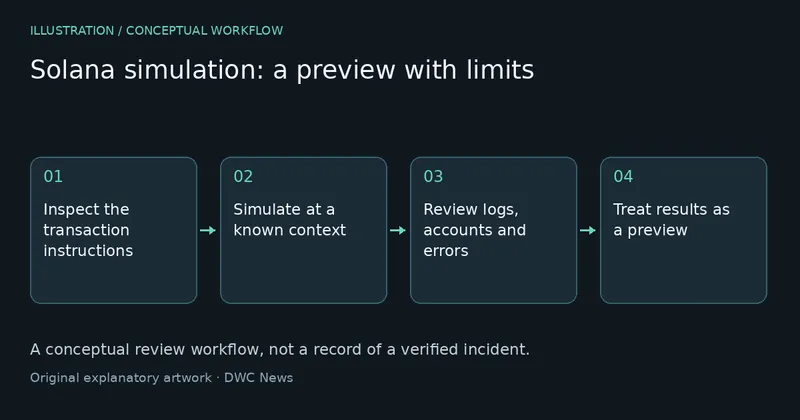
Illustration: a conceptual review workflow, not a record of a verified incident.
What the RPC method does
Solana’s official simulateTransaction reference describes evaluation using chain data at the requested commitment, without broadcasting the transaction. The request can specify settings such as signature verification, blockhash replacement and returned account information. Its result provides context and execution information, including errors, logs and consumed units.
The transaction need not be signed unless signature verification is requested. A simulation result must therefore be interpreted with its request settings, rather than treated as proof that a signed transaction has been submitted or will succeed later.
Review the context and the payload
| Item | Question |
|---|---|
| Transaction | Are these the actual instructions, accounts and signers you intend to authorize? |
| Context | Which commitment and chain state were used? |
| Result | Are there errors, unexpected program calls or account changes? |
| Changes after preview | Has the transaction or relevant state changed before submission? |
These are review questions, not a tested phishing detector. A result is an observation about the supplied simulation context. It does not establish that a website is trustworthy.
Keep fee estimates separate
A compute-budget calculation and an RPC execution simulation are different outputs. Neither a chosen compute limit nor a higher priority fee guarantees inclusion, prevents front-running or establishes that a token transfer is authorized as intended.
The DWC estimator should be assessed against its actual implementation. Its name alone does not prove that it sends an RPC simulation or reproduces the chain state used by a wallet.
Correction, 31 October 2026: Removed unsupported incident counts, a loss estimate, an unverified transaction identifier and an illustrative attack program previously presented as observed evidence. Removed claims that a program can universally detect simulation and that compute-budget settings guarantee protection. No on-chain incident or wallet exploit was reproduced for this guide.
Save the simulation context with the finding
For a reproducible review, retain the request settings and returned context beside the result. The RPC reference identifies sigVerify, replaceRecentBlockhash, commitment and minContextSlot as request parameters. A result from one request must not silently be presented as a result for a different payload or state.
A useful review record separates: transaction identity; requested commitment and blockhash behaviour; returned context; errors and logs; and any changed payload before signing. This is a recordkeeping method, not a claim that DWC reproduced an exploit or can certify a wallet request safe.
For website-identity evidence, use the domain and security worksheet. A successful simulation does not identify who controls a website.
Update, 31 October 2026: Added request-context recordkeeping and separated transaction observations from website identity.
Related Security Resources
- Wallet Drainer Intel: Signatures, Approvals and Incident Checks — technical breakdown of token allowances, EIP-712 messages, and Permit2 attack vectors.