Qubic Wallet Exploit Drains 1.4M From 1,400 Users
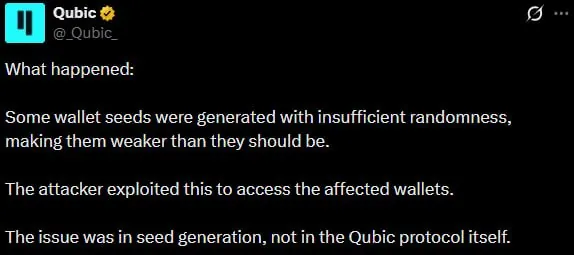
A flaw in the Qubic crypto wallet’s seed-phrase generator has allowed attackers to drain more than $1.4 million from over 1,400 wallets created before October 18. The vulnerability stems from weak, predictable seed phrases that let an adversary reconstruct private keys and access funds.
How the Weak Seed Phrases Were Exploited
Seed phrases in deterministic wallets are meant to be random and secure. In Qubic’s case, the algorithm produced phrases that fell short of entropy requirements, making them susceptible to brute-force or dictionary attacks. Once an attacker obtained a seed phrase, they could derive the corresponding private key and transfer the wallet’s balance to an external address. The Telegram post that first reported the breach notes that the attackers have been draining wallets continuously, implying a bot-driven operation.
Scope of the Theft
The Telegram message cites a total loss of $1,400,000 across 1,400 affected accounts. That averages roughly $1,000 per wallet, but the distribution is uneven; some wallets held tens of thousands of dollars, while others had only a few hundred. The attackers appear to target wallets indiscriminately, focusing on the weakness rather than the balance size.
Immediate Risk to Users
All wallets created before October 18 are flagged as vulnerable. Users who still hold funds in those accounts face an ongoing drain. The attackers have not announced a stop date, and the Telegram post warns that the draining continues. The only mitigation is to move remaining funds to a new wallet that uses a robust seed-phrase generator.
Why the Vulnerability Was Not Detected Earlier
Qubic’s seed-phrase algorithm was released with a public audit that did not cover entropy calculations. The audit focused on code correctness and transaction handling but omitted a formal randomness test. The oversight allowed the weakness to persist until the first victim reported the loss.
What Qubic Has Done So Far
The wallet’s developers issued a statement acknowledging the flaw and urged users to transfer assets immediately. No patch has been released yet, and the developers have not provided a timeline for a fix. The lack of a concrete remediation plan increases the window of opportunity for attackers.
How to Protect Yourself
- Check the creation date – If your wallet was created before Oct. 18, it is at risk.
- Move funds – Transfer all remaining balance to a new wallet that uses a proven seed-phrase generator, such as one based on BIP-39 with a full 128-bit entropy source.
- Verify the new wallet’s seed – Use a hardware wallet or a reputable software wallet that displays the seed phrase and allows you to confirm its randomness.
- Monitor activity – Keep an eye on the new wallet’s transaction history for any unauthorized movements.
- Stay informed – Follow the official Qubic channels and reputable security feeds for updates on patches or additional guidance.
Broader Implications for the Crypto Wallet Market
The Qubic incident highlights the importance of rigorous entropy testing in wallet design. Other wallets that rely on deterministic key generation but have not undergone formal randomness audits may be similarly exposed. The breach could prompt regulators to tighten standards for wallet security, especially for products that claim to be “user-friendly” or “paper-wallet-compatible.”
Related Security Alerts
Readers who have followed the recent AI wallet attack warning should note that both incidents involve seed-phrase weaknesses. The AI Wallet Attack: Bitcoin and Ether Holders Urged to Enter Bunker Mode article details how attackers exploited predictable phrases in a different wallet ecosystem.
Final Note
The Qubic exploit remains active, and the attackers have not signaled an end to the draining. Users with affected wallets must act immediately to safeguard remaining funds. The incident serves as a stark reminder that even popular wallets can harbor critical design flaws that, if left unchecked, can lead to large-scale theft.
Related coverage
- UK Trader Claims Nearly $800,000 Lost in Knife-Point Wrench Attack
- Ledger Reseller Crypto Theft: Investigation into Southeast Asian Vendor
- US Government Moves $1 Billion in Bitcoin From Bitfinex Hack Wallet Without Indicating a Sale